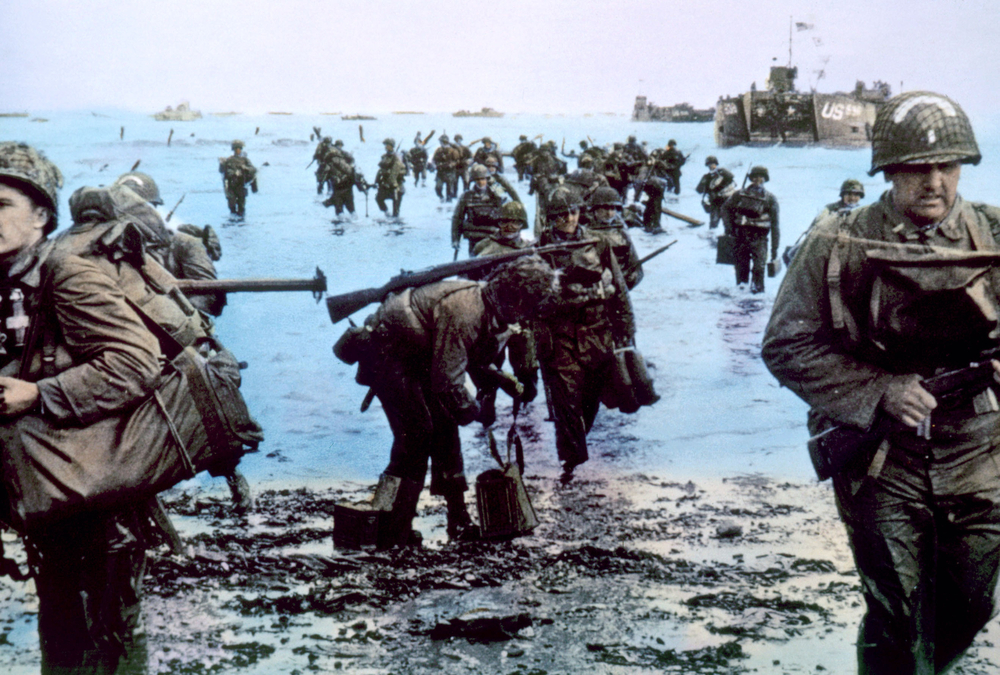
On June 6, 1944, Allied forces launched “Operation Overlord,” their assault on German-occupied northern France by storming the beaches at Normandy with the largest amphibious invasion in history. More than 156,000 Allied troops, supported by over 4,000 ships and 11,000 planes participated in the engagement. The battle turned the tide of the war and just under a year later, on May 8, 1945, Nazi Germany formally agreed to an unconditional surrender, ending World War II.
May 8 became known as VE-Day, for “Victory in Europe” and June 6 was known as “D-Day”. Why, though, “D-Day”? What does the letter “D” stand for? There’s a considerable amount of confusion about what the “D” meant, and even the commander of the invasion, General Dwight Eisenhower, seemed unsure. Many people today have come to assume that the “D” stood for “designated” or “decision.” Others believe it meant “debarkation” (in reference to the Allied forces disembarking from their landing crafts) or “deliverance” (in reference to freeing France from the occupying Nazi army). When General Eisenhower received a letter asking about the letter, he instructed his assistant to reply that it was an abbreviation for “departed”.
In fact, the term “D-Day” derives from what was the common military practice of abbreviating the precise day of a military operation as “D-day” and the precise hour as “H-hour.” The abbreviations were used when the exact day or time was either not yet decided upon, needed to be kept flexible, or needed to be kept secret. Thus, for example, an order could be issued that could call for a unit to perform a particular action at “H-hour,” or at “H-4,” meaning four hours before H-hour, or at “D+2,” meaning two days before D-day. An enemy who intercepted such a communication would be unable to determine the precise timing of the major attack, and thus the integrity of the operation would be preserved.
Not only does the abbreviation provide secrecy, but its use allows armed forces commanders to plan their troops’ movements and actions before any precise date or time for an operation is determined. This works particularly well in the case of operations, like the invasion of Normandy in 1944, that depended on multiple variables, such as tides and the repositioning of German units. Establishing a fixed date too early would have been strategically disastrous, so Allied commanders decided to remain flexible and simply referred to the day of action as “D-Day”. It turns out to have been a good move, too, since the original date for the invasion, June 5, ended up being plagued with bad weather that forced a last-minute delay in the operation.
According to the Center of Military History, this usage seems to have begun during World War I. The earliest example was Field Order Number 9, issued to the First Army, American Expeditionary Forces on September 7, 1918, reading, “The First Army will attack at H hour on D day with the object of forcing the evacuation of the St. Mihiel Salient.”